A Stone Falls in My Ear, 2022
Two-channel video installation with sound, loop
Dimensions variable
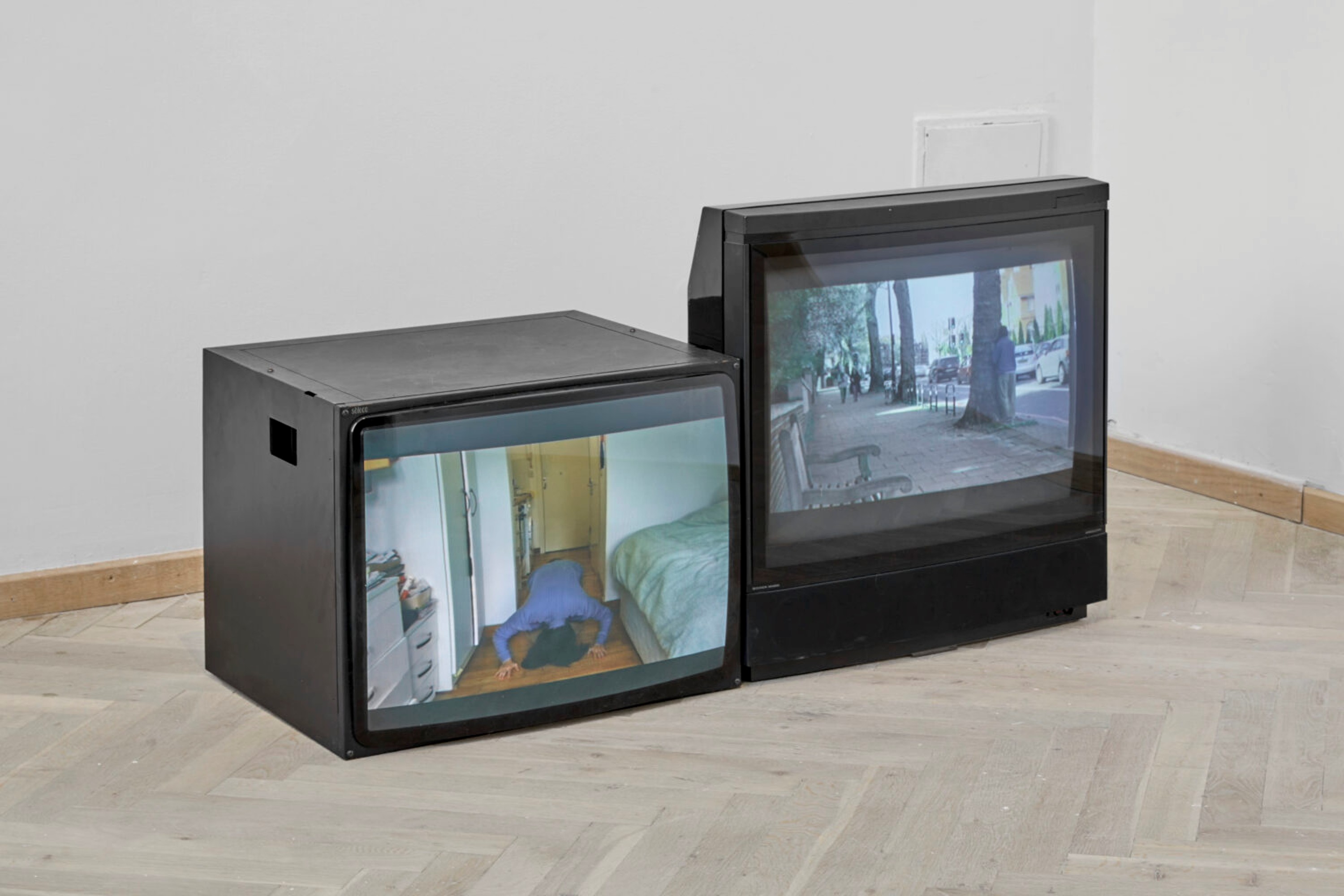
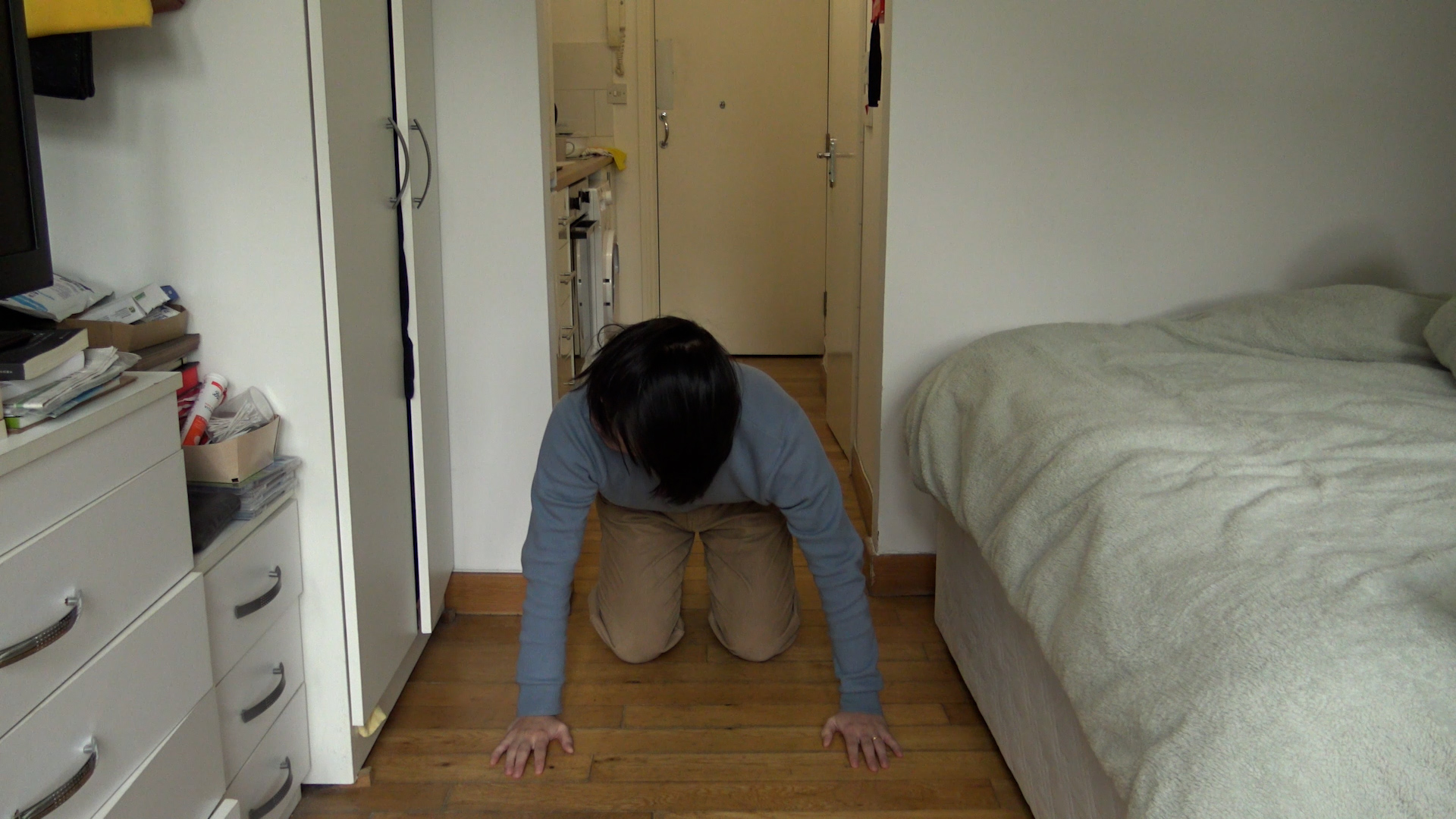
A Stone Falls in My Ear is a two-channel video work made in London. One screen shows me hiding behind a roadside tree, trying to avoid passersby. The other documents the repositioning manoeuvres for benign paroxysmal positional vertigo (BPPV)—a condition I briefly developed after arriving in the UK.
BPPV happens when tiny calcium crystals in the inner ear become dislodged and drift into the wrong canal, sending false signals about the body's position in space. The treatment involves a series of precise head movements designed to guide the stones back where they belong. It's a strange ailment—your body tells you you're falling when you're perfectly still, that the world is spinning when nothing has moved.
The pairing of these two videos creates a parallel between physical and social disorientation. Hiding behind a tree to avoid strangers is its own kind of vertigo, a hyperawareness of being watched or out of place. There's something almost childish about it, but also something that speaks to the acute self-consciousness of existing in a space where you don't quite belong, where your presence feels provisional or suspect.
As an immigrant, you're constantly recalibrating. You learn new gestures, new distances, new ways of taking up space. The body itself becomes a site of adjustment—not just culturally or socially, but physiologically. BPPV felt like a physical manifestation of that larger disorientation, the sense that the ground beneath you isn't stable, that your internal sense of balance no longer matches the external world.
Politically, the work touches on visibility and evasion. The act of hiding is both defensive and absurd—a refusal to be seen that also makes you more conspicuous. It's the logic of the migrant subject: hypervisible and invisible at once, always aware of being potentially out of place. The tree offers no real cover, just the thin fiction of it.
The repositioning exercises, meanwhile, are about correction—forcing the body back into alignment through repetition and submission to a prescribed protocol. There's something both clinical and comedic about those movements, the strange intimacy of following instructions to fix something inside yourself that you can't see or directly control.
The title holds both meanings together: the literal stone in the ear, and the sense of something falling, slipping, becoming untethered. The work loops, because neither condition fully resolves. The stones might settle for now, but the sense of precarity remains. You step out from behind the tree, but you're still aware of it, still mapping escape routes, still feeling the ground tilt slightly beneath your feet.