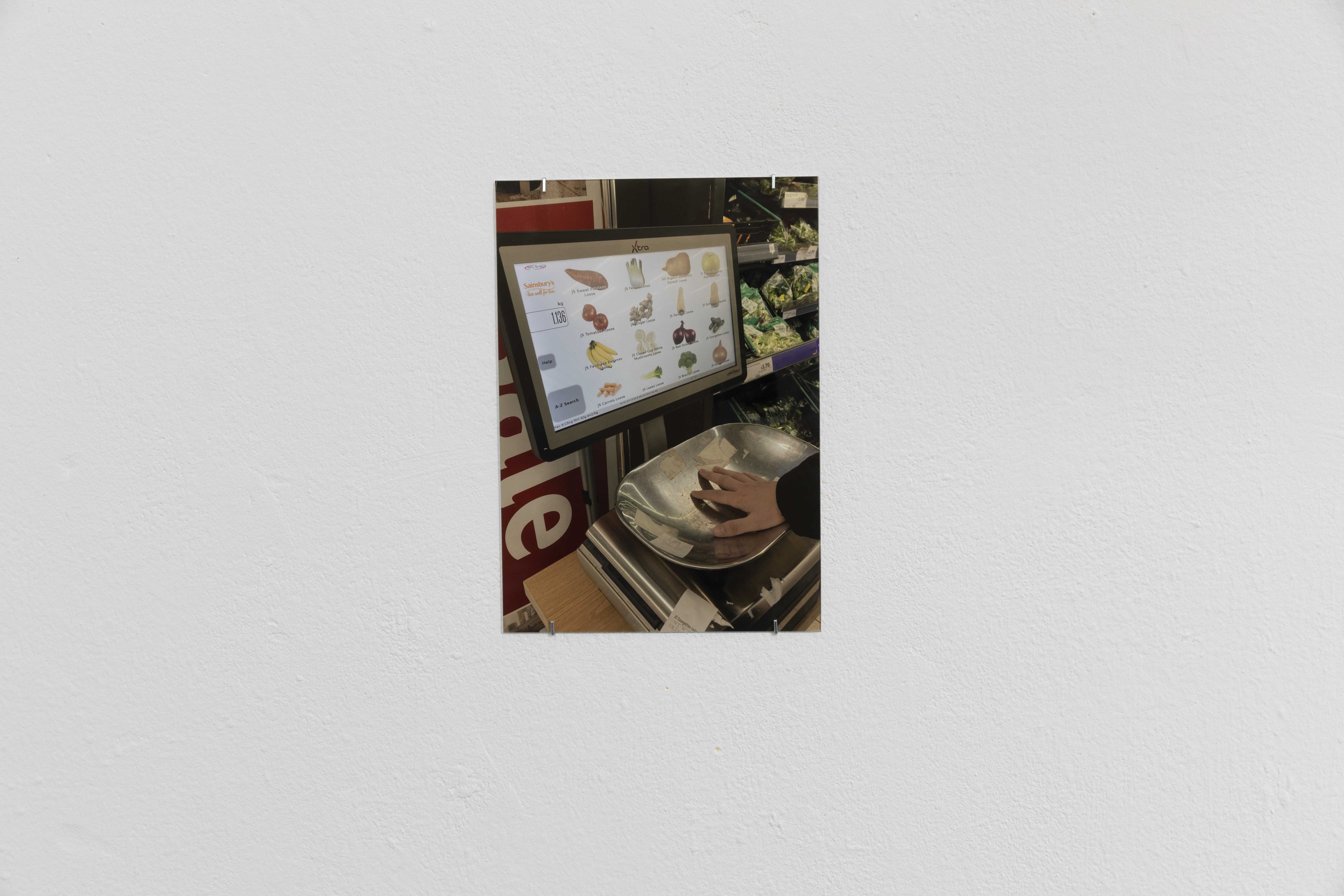
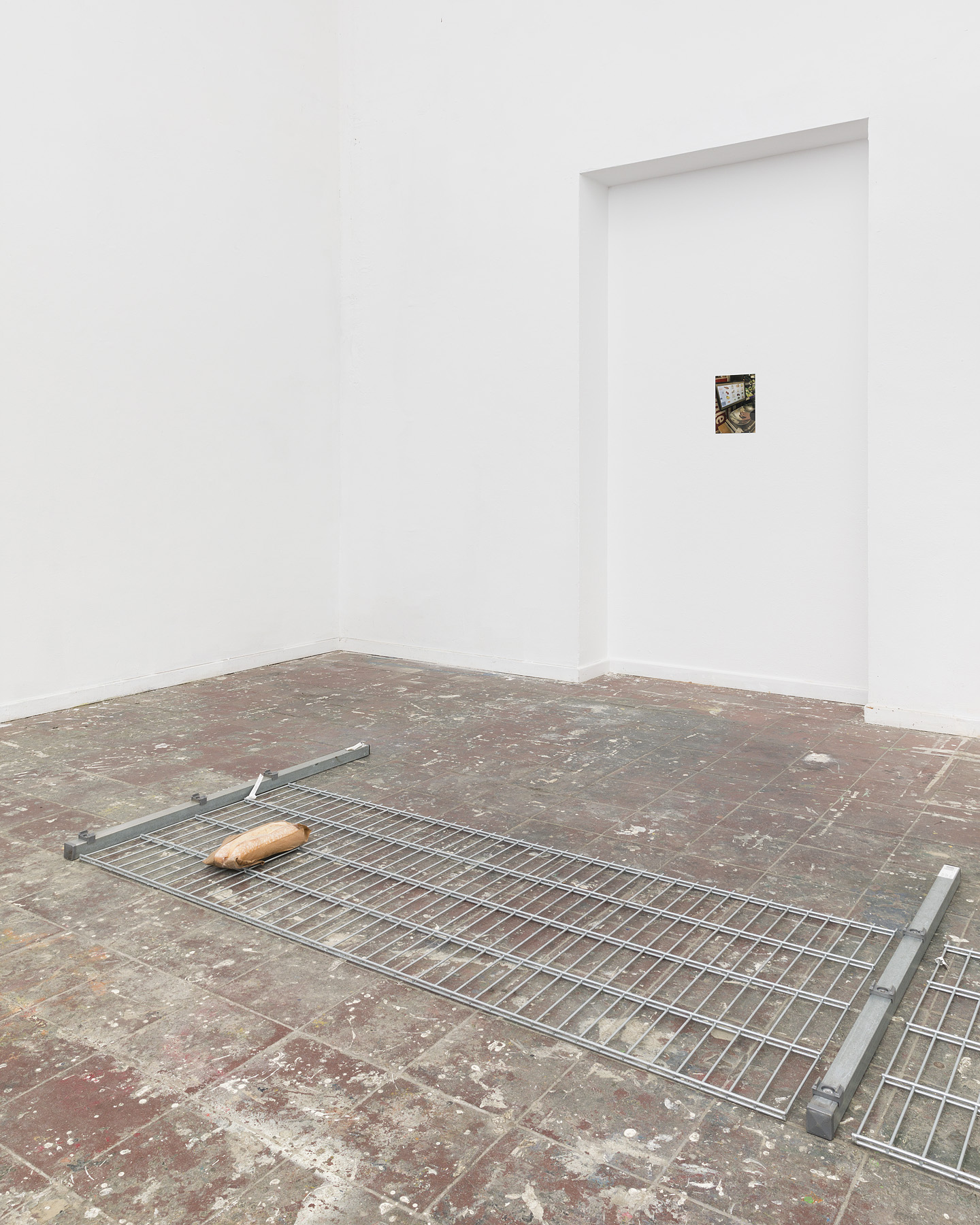
Death Is an Invisible Tiger, 2024
C-print, glass, nails, I pressed my hand on a supermarket scale, and the weight displayed was that of a newborn tiger.
21 x 29.7 cm
I pressed my hand on a supermarket scale. The weight it displayed matched that of a newborn tiger.
The tiger carries enormous symbolic weight in Asian cultures—it appears on amulets, in folklore, as guardian figures at temple gates. It represents power, protection, ferocity. In Chinese tradition, the tiger wards off evil spirits; children wear tiger-head shoes to keep them safe. But the tiger is also deeply political. It has been conscripted into nationalist imagery, printed on propaganda, invoked as a symbol of strength and territorial dominance. The tiger that protects can also threaten. The same image that comforts a child can be weaponized.
A newborn tiger weighs roughly the same as a human hand pressed flat against a scale. This equivalence is accidental, arbitrary—but once noticed, it opens something up. The hand becomes a stand-in for latent violence, for potential force not yet realized. A newborn tiger is blind, vulnerable, barely capable of survival. But it carries within it the inevitability of what it will become.
The supermarket scale is an odd place for this revelation. It's a mundane instrument meant for weighing produce, for calculating value and cost. Using it to weigh a hand turns the body into commodity, into something measurable and exchangeable. The hand pressed down is both intimate and exposed—palm flattened, fingers spread, held in place by its own weight. There's a quiet violence in the pressure required to register on the scale, the body bearing down on itself to produce a number.
The title introduces death, which doesn't appear directly in the image. But the tiger has always been associated with mortality—as predator, as danger, as the force that can kill you. In classical Chinese thought, the tiger is one of the four sacred animals, tied to the west and to autumn, the season of decline. "Death is an invisible tiger" suggests that the threat is always present but unseen, that power operates even—or especially—when it can't be directly observed.
The hand on the scale becomes a gesture of self-measurement under an invisible authority. We weigh ourselves constantly—our words, our movements, our presence in spaces that may or may not want us. The body learns to calibrate its own pressure, to know how much weight it can safely exert before something breaks or someone notices. The newborn tiger inside the hand is both metaphor and warning: the violence you carry, the violence that might be carried against you, the way vulnerability and threat can occupy the same small space, measured in grams.