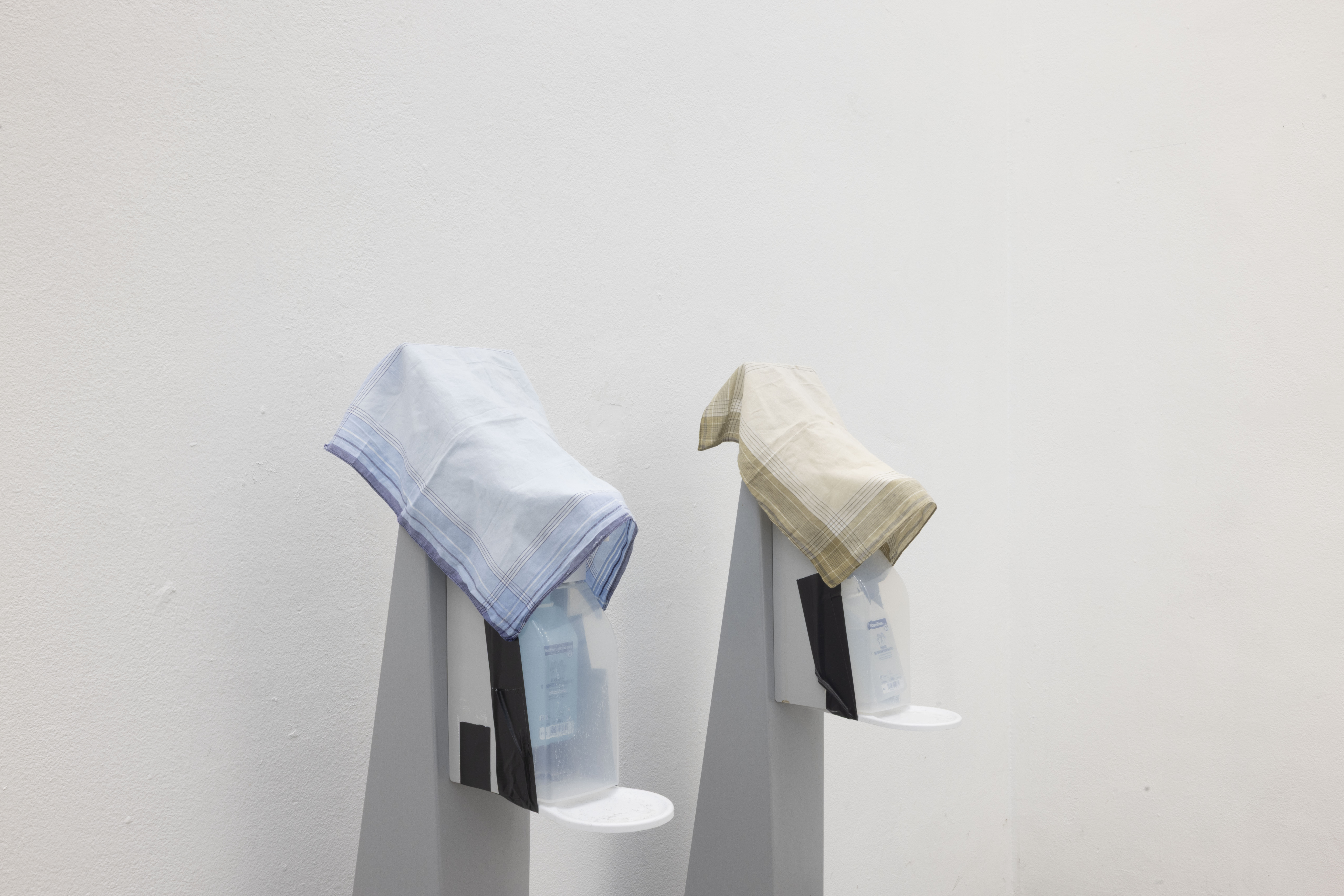
When You Are Back, I Will Kill a Sheep for You, 2026
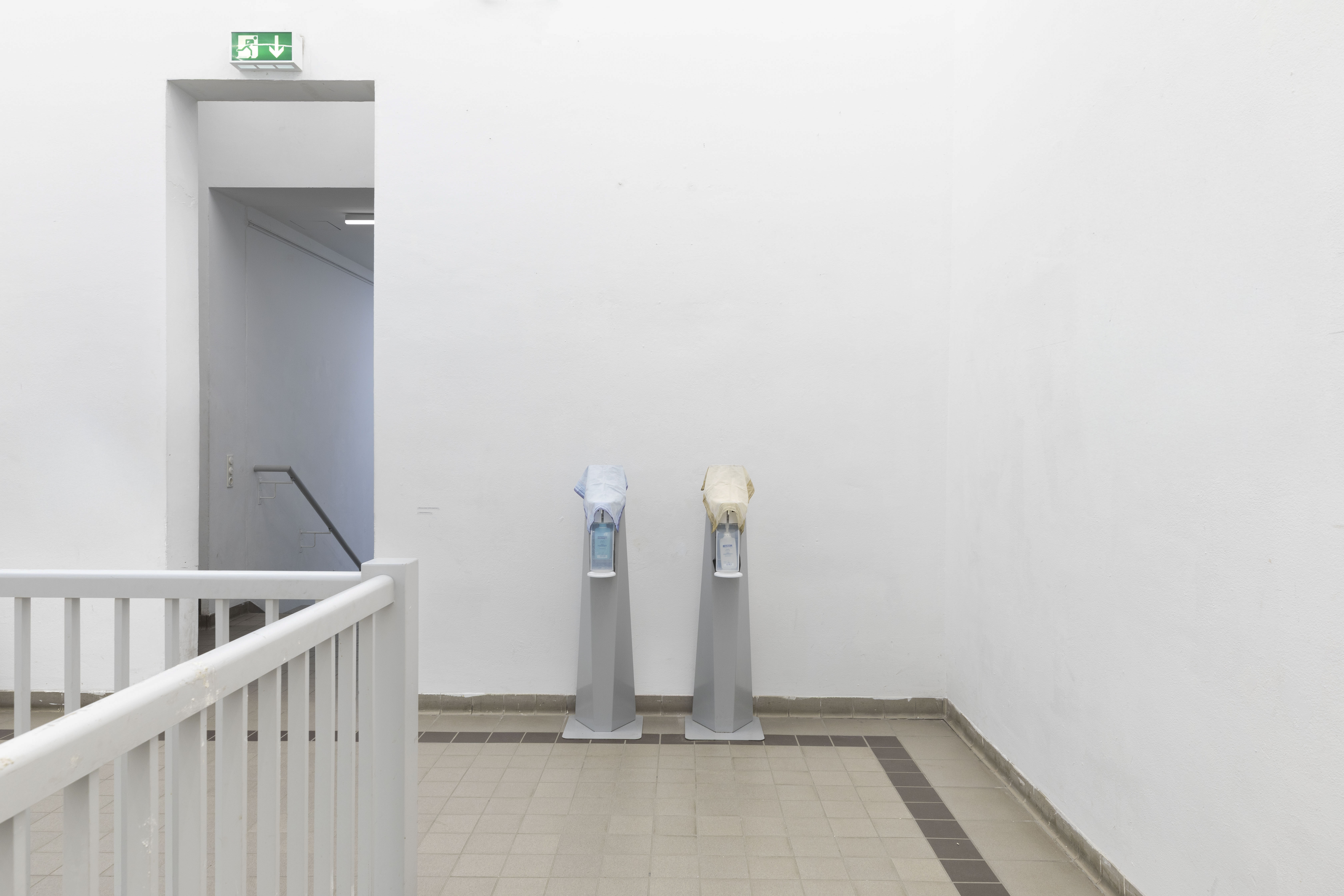

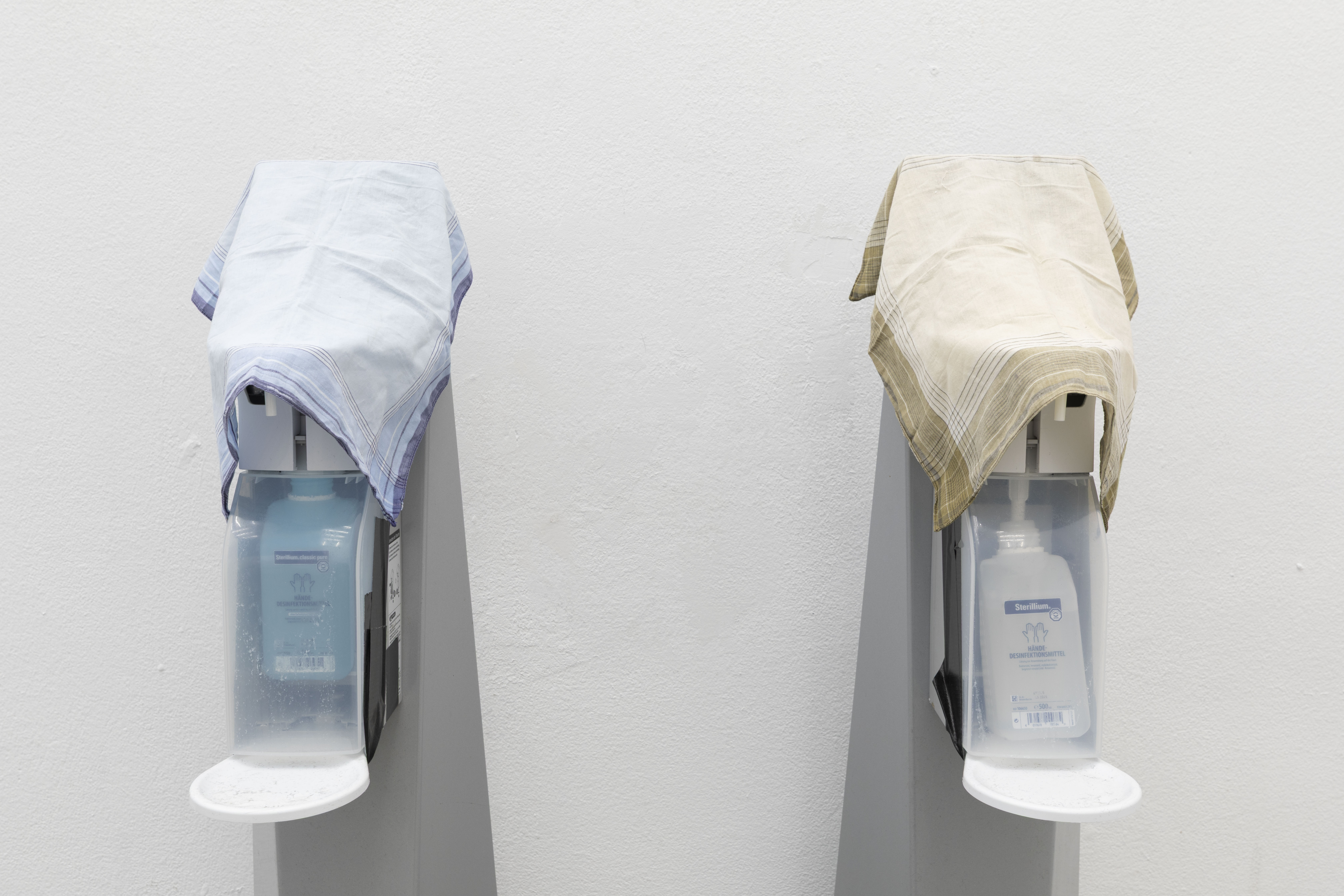
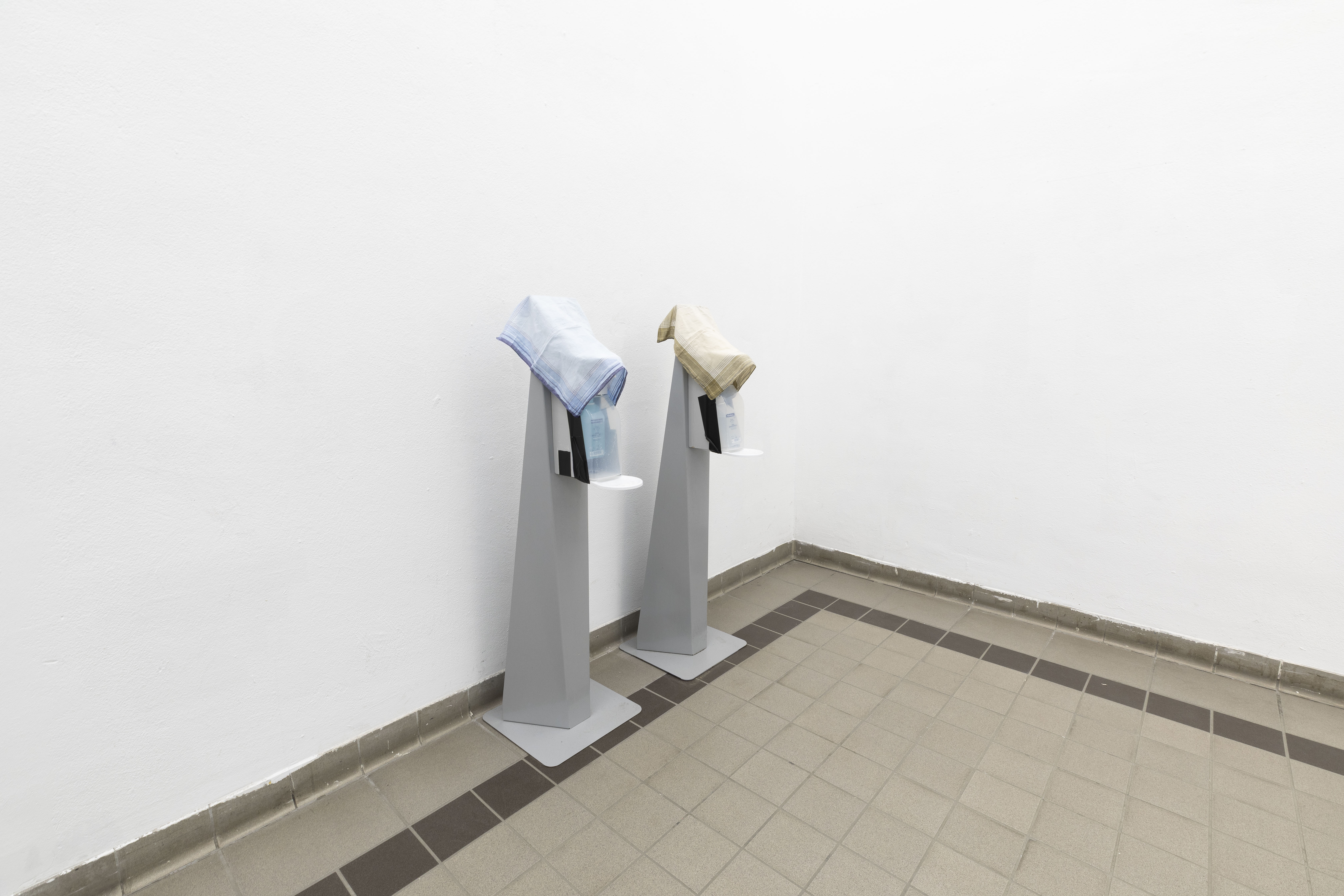
Two square handkerchiefs are placed over two used alcohol sanitiser dispensers on grey pedestals.
Dimensions variable
The work takes its title from a sentence my father once said to me. In the context of northern China, killing a sheep is not an everyday act, but a serious and ceremonial gesture, reserved for an important return. Through years of being away from home, this sentence shifted from a concrete promise into a suspended expectation — a phrase carrying the weight of separation, delayed time, and unresolved emotion.
The work consists of two hand-sanitizer dispensers commonly found in public spaces. I covered them with cloth handkerchiefs, obscuring their original function. Through this simple intervention, the forms begin to resemble two upright animals, standing side by side. They appear to be waiting, yet also frozen, caught in a moment that never fully arrives. The cloth both domesticates and veils the objects, producing a ghost-like presence, as if something absent is being carefully preserved.
Here, objects associated with public hygiene and institutional order are placed in dialogue with an intimate, rural expression of care and hospitality. The logic of disinfection and cleanliness collides with ideas of return, sacrifice, and bodily closeness. Rather than depicting a literal family scene, the work uses displacement and abstraction to evoke the experience of diaspora — where promises remain unfulfilled, gestures are deferred, and emotional bonds persist in suspended form.
This work establishes a structure of tension between public infrastructure and private emotion. Sanitizer dispensers, as fixtures of public space, represent collective hygiene management, standardized service, and the impersonal discipline of everyday life. They are functional, mass-oriented objects, existing in transit hubs, shopping centers, hospitals — spaces of circulation and anonymity. Yet when handkerchiefs — intimate textiles carrying personal memory, familial warmth, and bodily touch — are draped over them, these public objects are invested with private narrative.
The covering gesture operates simultaneously as tender care (like clothing an animal for warmth) and as a symbolic ritual of mourning (like shrouding what has passed). Through this transformation, the cold apparatus of public hygiene is reimagined as living beings awaiting return, while private emotional projection seeps into the materiality of public space. The superimposition creates a temporal and spatial dislocation: collective experiences of public places and individual wounds of family separation meet within the same object, belonging neither fully here nor able to truly return there.
This duality is also embedded in the act of "killing a sheep" itself — a gesture that is deeply private and familial, yet must be performed publicly within the community, becoming a social ritual on display. Through the juxtaposition of materials, the work materializes this ambiguity of public-private boundaries, revealing how, within contemporary conditions of mobility, individuals navigate between public systems and intimate emotions in search of belonging, and how promises that gradually become estranged through waiting are preserved and mourned in object form.